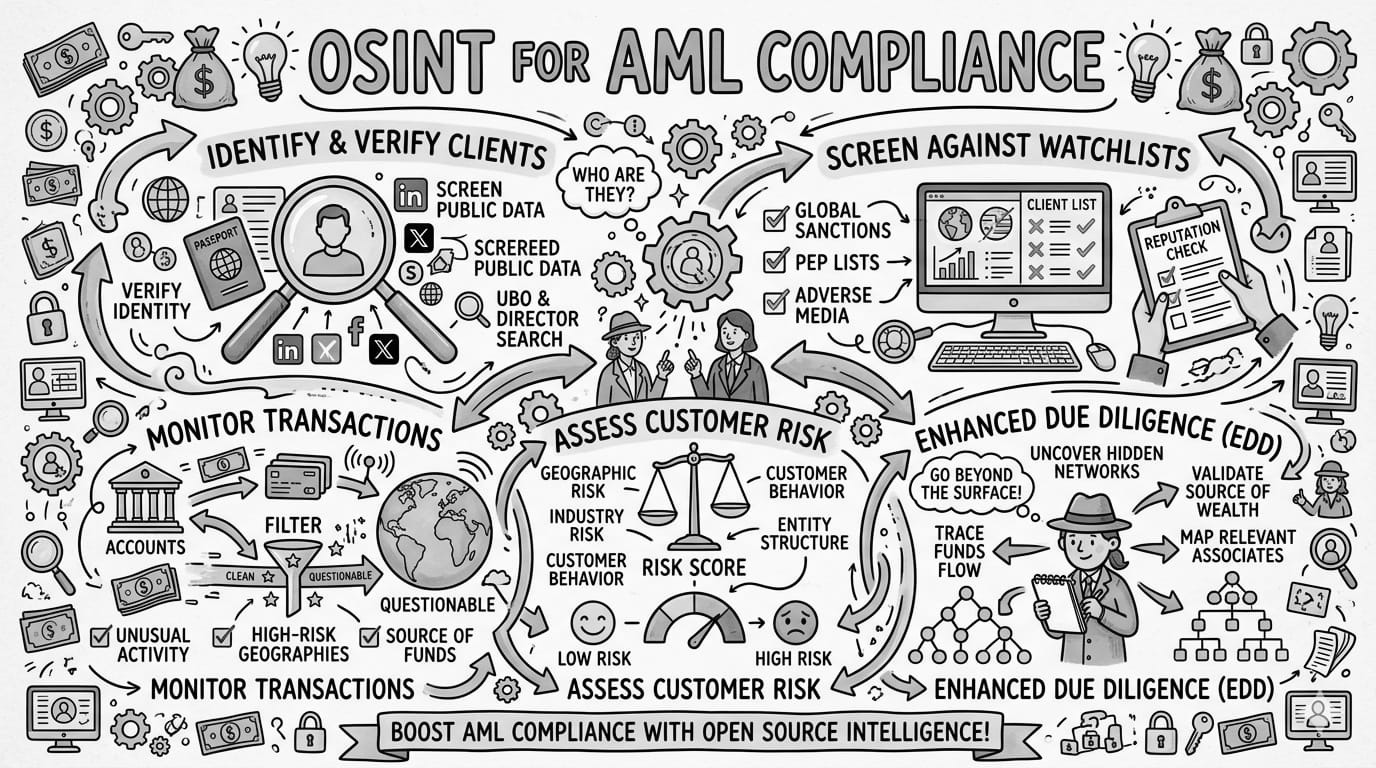
Anti-money laundering compliance has never been more complex or more consequential. Global regulatory fines for AML failures exceeded USD 6 billion in 2024. Regulators in Singapore (MAS), the European Union (AMLA), and the United States (FinCEN) are intensifying enforcement, and the definition of "reasonable due diligence" is being interpreted more broadly with every enforcement action. At the same time, financial criminals are increasingly sophisticated in their use of shell companies, cryptocurrency layering, trade-based money laundering, and cross-jurisdictional structures designed to obscure beneficial ownership. Detecting these schemes requires the ability to correlate information across many data sources quickly and accurately. This is precisely where OSINT automation delivers transformative value.
OSINT Automation: Key Capabilities for AML Teams
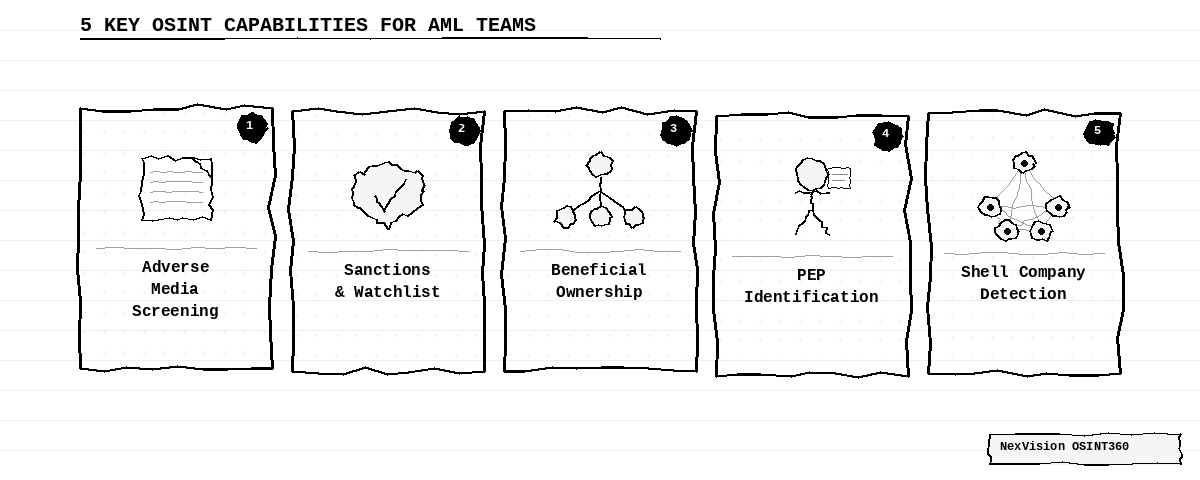
- Adverse media screening across news, government publications, and regional databases
- Embedded sanctions and watchlist screening with timestamped audit trails
- Automated beneficial ownership and UBO mapping across jurisdictions
- PEP identification covering family members, close associates, and lower-profile officials
- Shell company network detection through shared infrastructure analysis

Where OSINT Fits in the AML Compliance Workflow
Open-Source Intelligence plays a role at multiple stages of the AML compliance lifecycle. Understanding where OSINT adds value helps compliance teams prioritise automation investments for maximum impact.
Customer Onboarding (KYC)
Identity verification, adverse media, PEP status, beneficial ownership
Instant multi-source screening; structured entity profiles
Ongoing Monitoring
Continuous watchlist screening, adverse news monitoring, corporate structure changes
Automated alerts on entity changes; no manual re-checking
Transaction Monitoring Alerts
Rapid counterparty research; identifying shell company patterns
Investigation time reduced from hours to minutes per alert
SAR Reporting
Comprehensive entity profiling and relationship mapping
Structured case history automatically available for SAR documentation
Enhanced Due Diligence (EDD)
Deep-dive on high-risk customers, beneficial owners, complex structures
Cross-entity correlation surfaces connections manual research would miss
The Five OSINT Capabilities Every AML Team Needs
1. Adverse Media Screening
Adverse media — negative news coverage linking a person or entity to financial crime, corruption, fraud, or sanctions violations — is a cornerstone of AML due diligence. Manual adverse media screening is notoriously unreliable: keyword searches return too many false positives, important stories in local languages are missed, and there is no systematic way to assess the severity or credibility of findings.
Automated adverse media screening uses structured queries across news databases, government publications, court records, and regional media to identify relevant negative coverage. AI-assisted analysis then classifies findings by severity, source credibility, and relevance — dramatically reducing the time analysts spend reading irrelevant results.
2. Sanctions & Watchlist Screening
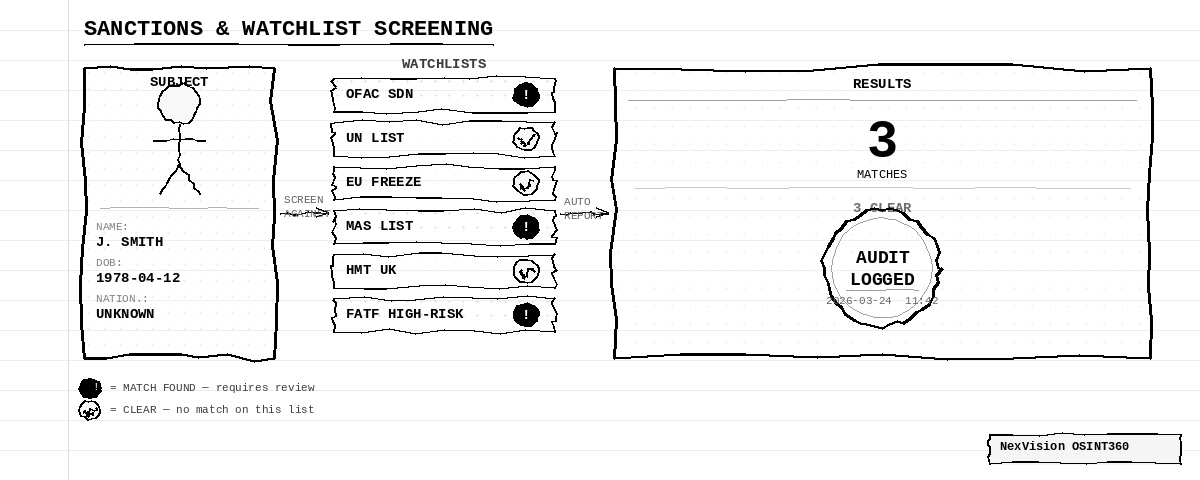
Every AML compliance function must screen against sanctions lists — OFAC SDN, UN consolidated list, EU asset freeze list, FATF high-risk jurisdictions, MAS Singapore list, and more. Maintaining manual processes for this is both operationally risky and increasingly untenable as listed entities grow.
3. Beneficial Ownership Research
Complex ownership structures — layered holding companies, nominee arrangements, trust structures, and cross-jurisdictional incorporations — are the primary tools used to conceal the true beneficial owners of illicit funds. Mapping these structures manually requires accessing company registries across multiple jurisdictions and tracing ownership chains by hand — a process that can take days for a complex case.
Automated beneficial ownership research leverages entity correlation to map corporate structures rapidly, connecting UBO relationships across jurisdictions and flagging structures consistent with ownership obfuscation patterns.
4. PEP Identification and Monitoring
Politically Exposed Persons (PEPs) require enhanced due diligence under FATF Recommendations 12 and 13. PEP status extends to family members, close associates, and lower-profile officials at the regional and local level — where manual identification is unreliable. Automated PEP screening cross-references subjects against curated PEP databases, government records, and open-source biographical data with the source trail necessary for regulatory documentation.
5. Network Analysis for Shell Company Detection
Shell companies used for money laundering frequently share registered addresses, directors, phone numbers, email domains, and bank accounts — connections that are invisible when entities are reviewed in isolation but immediately apparent through cross-entity correlation. Automated relationship mapping builds a real-time network graph as investigation data is collected, surfacing these shared infrastructure patterns rapidly.
How OSINT360 Enhances AML Compliance: Precision, Accuracy & Actionable Intelligence
NexVision OSINT360 was designed to go beyond basic OSINT crawling. By integrating advanced machine learning, NLP, and entity correlation models, OSINT360 transforms overwhelming raw data into verified, contextualised, and actionable compliance intelligence.
AI-Powered False Positive Reduction — OSINT data often includes misleading or duplicate information. OSINT360's AI intelligently filters and correlates entities by analysing behaviour patterns, contextual signals, metadata quality, and confidence-scoring models, ensuring investigators receive only high-accuracy, verified intelligence.
Automated Data Analysis & Correlation — AI uncovers and maps complex relationships across aliases, social accounts, IPs, domains, emails, breach datasets, and geolocation clues. Investigators receive a unified intelligence graph that visualises connections, highlights risk levels, and presents timelines — making analysis faster, clearer, and more accurate.
Integrated Compliance Intelligence — Sanctions and watchlist screening is embedded directly into investigation workflows. Analysts can rapidly assess individuals, companies, and legal entities against compliance-related indicators without relying on external platforms.
The Regulatory Landscape Driving OSINT Adoption in AML
Regulatory guidance across major jurisdictions is increasingly explicit about the expectation that financial institutions will leverage technology — including AI and automation — to improve AML programme quality and consistency.
MAS Notice 626 (Singapore) — CDD measures must be commensurate with the risk profile of the customer, implying comprehensive data sources for high-risk customers
FATF Recommendation 10 — Requires thorough KYC measures including ongoing monitoring of the business relationship
EU 6th Anti-Money Laundering Directive (6AMLD) — Introduces stricter beneficial ownership requirements and broader predicate offence definitions
FinCEN (United States) — Proposed rulemaking requires more rigorous beneficial ownership collection and verification for legal entity customers
Institutions that rely on manual OSINT processes face growing regulatory risk — not just from missed findings, but from the inability to demonstrate systematic, consistent, and documented due diligence at scale.