in Organisations-NexVision.jpg)
Human Resources teams sit at one of the most sensitive intersections in any organisation — they make decisions that determine who gains access to systems, data, people, and corporate assets. Yet the tools most HR departments rely on for candidate vetting, background screening, and employee monitoring have not kept pace with the threat landscape they now face. Open-Source Intelligence (OSINT) changes that equation. By systematically collecting and correlating publicly available information — from social media profiles and court records to corporate registry filings and leaked credential databases — OSINT gives HR professionals a structured, repeatable method for verifying identity, uncovering risk, and protecting the organisation before, during, and after the hiring process.
OSINT for HR: Key Applications
• Pre-hire background screening across social media, court records, and adverse media databases
• Identity and credential verification to confirm qualifications and employment history
• Insider threat detection through continuous behavioural and digital monitoring
• Executive due diligence for senior appointments and board-level hires
• Vendor and contractor vetting before granting access to sensitive systems or data
Why Traditional HR Screening Is No Longer Enough
Most organisations still rely on the same pre-hire screening process they used a decade ago: a reference check, a criminal background check through a third-party provider, and a review of the CV the candidate submitted. This approach has fundamental gaps that OSINT directly addresses.
Reference checks depend on the candidate selecting who speaks about them. Criminal background checks vary widely in scope depending on jurisdiction and the depth of the search. And a candidate's own CV is, by definition, a curated self-presentation — not an independent verification of facts.
Meanwhile, the digital footprint every person leaves across social platforms, professional networks, public records, news archives, and online communities contains a far richer and more objective picture of who that person is, what they have done, and what risks they might represent to your organisation.
A 2024 survey of enterprise HR and security teams found that more than 40% of insider threat incidents involved individuals who had passed standard pre-hire background checks. The information that would have flagged the risk was publicly available — it simply was not collected or correlated systematically.
Where OSINT Fits in the HR Lifecycle
OSINT is not a single tool used at one point in the employee lifecycle. It delivers value across the entire journey — from the moment a candidate applies to the day an employee departs.
Pre-Hire Screening
Resume and qualification verification against publicly available records, LinkedIn profiles, and institutional databases
Employment history cross-referencing across professional networks and corporate registries
Adverse media screening: news coverage linking the candidate to fraud, misconduct, litigation, or regulatory action
Social media analysis to assess professional conduct, public statements, and reputational risk
Identity Verification
Confirming that the identity presented matches public records, professional profiles, and digital footprints
Detecting identity fraud, alias usage, or discrepancies between claimed and verifiable background
Validating professional licences, certifications, and academic credentials through publicly accessible institutional sources
Ongoing Employee Monitoring
Continuous adverse media monitoring for current employees, especially those in sensitive or privileged roles
Alerting on changes to professional status, new directorships, or affiliations that may represent a conflict of interest
Detecting signs of disengagement, external job searching, or activity on competitor platforms that may indicate departure risk
Insider Threat Detection
Correlating digital behaviour patterns with external signals — social media content, forum activity, dark web presence — to identify elevated insider risk
Identifying employees who may have been targeted for social engineering by external threat actors
Flagging connections to sanctioned entities, organised crime networks, or foreign state-affiliated actors
Exit and Post-Employment Risk
Monitoring for public disclosure of confidential information following departure
Tracking whether a departing employee has joined a direct competitor in breach of non-compete obligations
Detecting misuse of corporate identity or credentials on public platforms

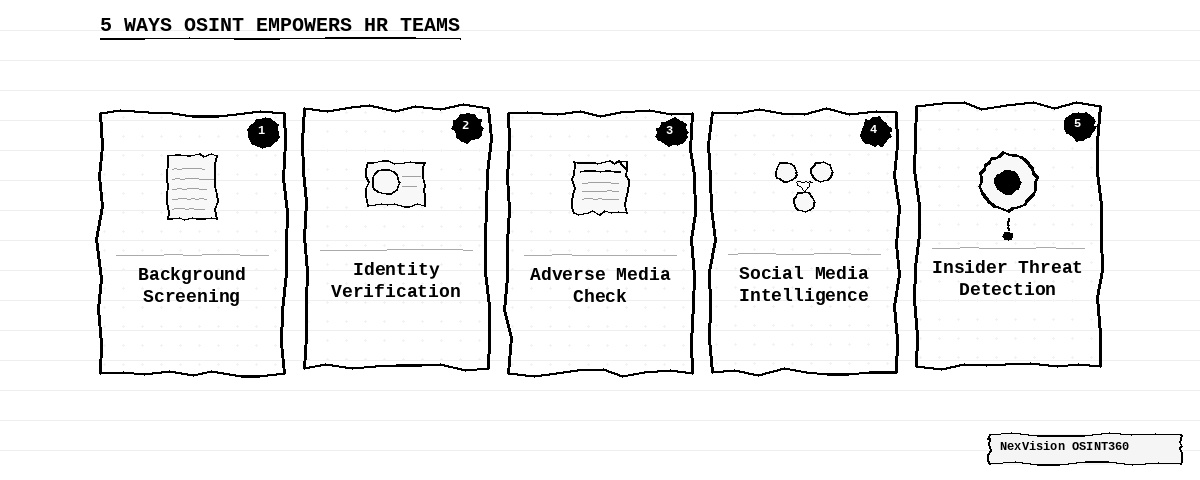
Five OSINT Capabilities Every HR Team Needs
1. Background Screening
Automated background screening goes far beyond a criminal record check. A structured OSINT investigation for a new hire should cover court records and civil litigation history, adverse media across regional and international publications, corporate affiliations and directorships that may indicate conflicts of interest, sanctions and watchlist checks for regulated industry roles, and any online presence that suggests dishonest or harmful conduct.
The key to doing this well is not the number of sources checked — it is the structure of the investigation. Guided investigation templates ensure that every candidate is assessed against the same checklist, every time, regardless of which HR professional or security analyst runs the check.
2. Identity Verification
Identity fraud in hiring is more common than most organisations acknowledge. Candidates present false credentials, fabricate employment history, or assume partially constructed identities to pass standard checks. OSINT-based identity verification cross-references the identity a candidate presents against their publicly verifiable digital footprint — LinkedIn profile history, professional association memberships, published work, conference participation, and institutional records — to surface inconsistencies that would not appear in a standard reference check.
3. Adverse Media Check
News archives, court reporting, regulatory enforcement publications, and local media contain information that does not appear in criminal record databases. A candidate may have been named in civil litigation, regulatory proceedings, or investigative journalism without ever being convicted of a criminal offence. Automated adverse media screening queries these sources systematically, classifies findings by severity and credibility, and surfaces relevant results for analyst review — eliminating the noise and reducing the risk of missed findings.
4. Social Media Intelligence
A candidate's public social media presence offers a window into their values, professional conduct, and potential reputational risk to the organisation. This is not about monitoring personal opinions — it is about identifying patterns of behaviour that indicate a material risk: evidence of dishonesty or misrepresentation, expressions of hostility toward the organisation or its customers, connections to individuals or groups that represent a security concern, or public conduct that is inconsistent with the role the candidate is being hired for.
OSINT platforms can aggregate and analyse social media presence across platforms, detect alias accounts, and provide a structured assessment of publicly observable behaviour patterns.
5. Insider Threat Detection
Insider threats represent the most underestimated risk in enterprise security. A 2023 Ponemon Institute study found that the average cost of an insider threat incident reached USD 16.2 million — and that 55% of incidents were caused not by malicious intent but by negligence or compromised credentials. OSINT supports insider threat programmes by providing continuous monitoring of external signals that may indicate elevated risk: signs of financial distress in public records, sudden changes in professional profile, activity on dark web forums, or detection of corporate credentials in breach datasets.
How OSINT360 Supports HR and Security Teams
NexVision OSINT360 was designed to give analysts, investigators, and compliance professionals a single structured platform for conducting repeatable, audit-ready OSINT investigations. For HR and corporate security teams, this means:
Guided Investigation Templates for HR Use Cases — Pre-built workflows for pre-hire screening, executive due diligence, vendor vetting, and insider threat assessment ensure that every investigation follows best-practice methodology, regardless of who runs it.
Entity-Based Profile Building — OSINT360's entity engine builds structured profiles around the subject of an investigation — linking people to companies, addresses, digital identifiers, and public records — providing a complete picture rather than a collection of disconnected data points.
Automated Adverse Media and Sanctions Screening — Integrated screening against sanctions lists, watchlists, and adverse media databases eliminates manual multi-source checking and ensures comprehensive coverage with a timestamped audit trail.
AI-Assisted Analysis — The platform's AI assistant accelerates interpretation of large volumes of collected data, summarising findings, flagging anomalies, and generating preliminary assessments that the HR or security professional can then review and act on.
Audit-Ready Case Management — Every investigation is recorded in a centralised case management system, providing the documented evidence trail that HR and legal teams need to support hiring decisions, disciplinary processes, and regulatory enquiries.
Legal and Ethical Considerations
OSINT-based HR investigations must be conducted within the legal and ethical frameworks applicable to the organisation's jurisdiction. Key considerations include:
Data protection compliance — In Singapore (PDPA), the European Union (GDPR), and other jurisdictions, the collection and processing of personal data for employment purposes is subject to specific legal requirements including purpose limitation, data minimisation, and consent or legitimate interest grounds.
Scope proportionality — The depth and breadth of an OSINT investigation should be proportionate to the sensitivity of the role. A warehouse operative does not require the same depth of screening as a Chief Financial Officer or someone with privileged access to sensitive systems.
Transparency obligations — Many jurisdictions require that candidates be informed that background screening will be conducted, and in some cases that they have a right to access and challenge the results.
Non-discrimination — OSINT investigations must be applied consistently across all candidates for equivalent roles to avoid the risk of discriminatory screening practices.
A well-implemented OSINT programme does not replace legal counsel — it provides the intelligence that informs legally sound decisions. Platform tooling like OSINT360 supports compliance by maintaining complete audit trails of what was collected, from where, and when.
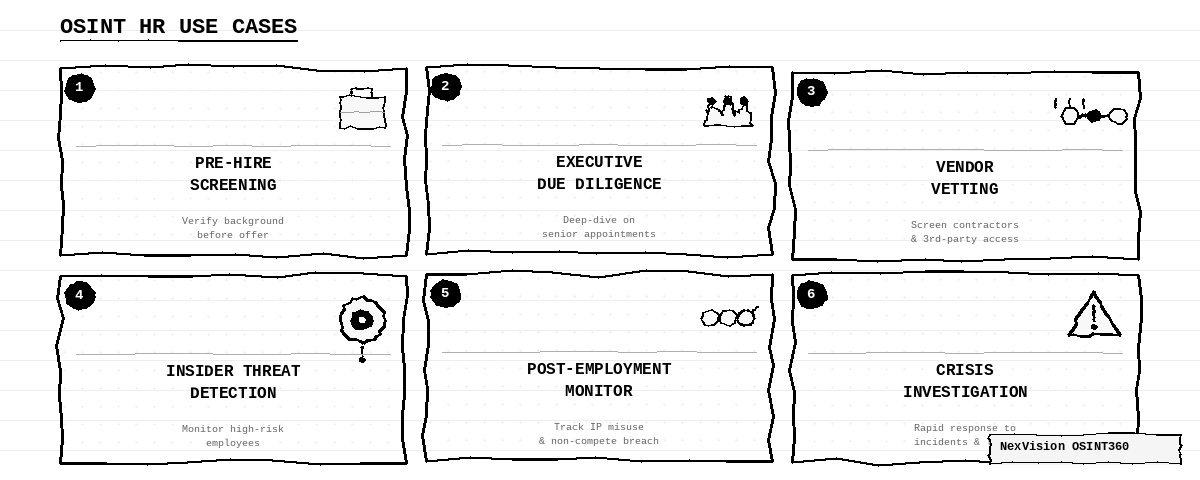
HR Use Case | OSINT Application | What Automation Adds | |
|---|---|---|---|
Pre-Hire Screening | Adverse media, court records, social media, credential verification | Consistent coverage across all candidates; audit-ready findings report | |
Identity Verification | Cross-reference identity against public digital footprint | Discrepancy detection that manual review would miss | |
Executive Due Diligence | Deep-dive on corporate affiliations, litigation, media coverage, financial exposure | Entity correlation surfaces connected risks across jurisdictions | |
Vendor / Contractor Vetting | Sanctions screening, beneficial ownership, adverse media | Automated multi-list screening with timestamped records | |
Insider Threat Monitoring | Ongoing adverse media, dark web monitoring, credential breach detection | Continuous automated alerts on elevated-risk signals | |
Post-Employment Monitoring | Brand and IP misuse, non-compete breach signals, credential exposure | Automated detection without manual searching |